
- Solutions
Back to Knowledge Center
Why Freight Management Needs Business Intelligence
Use business intelligence to improve freight management, reduce costs, evaluate carrier performance and gain real-time supply chain visibility.
May 21, 2025 — 4 Min Read
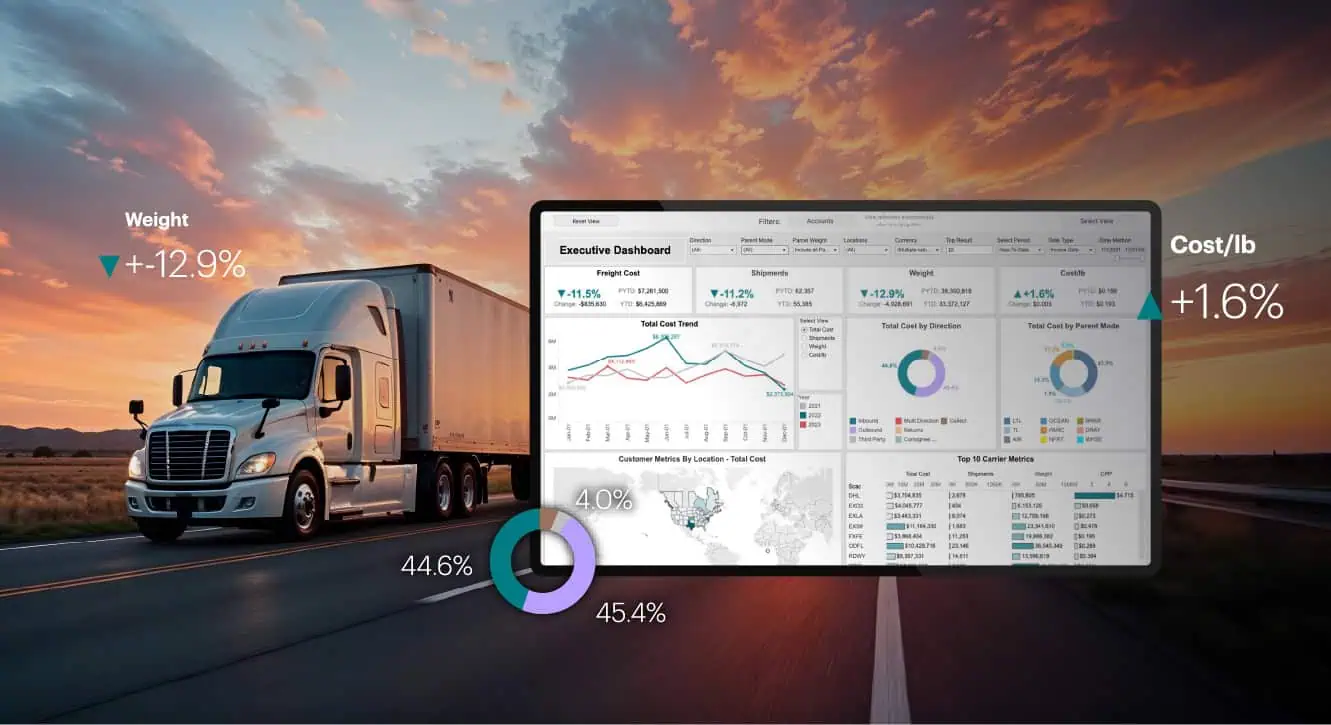
Transportation is one of the largest controllable expenses in the supply chain. Yet, many companies struggle to manage freight costs due to unpredictable rate fluctuations, capacity shortages and inconsistent service levels across carriers.
Too often, carrier selection is based on familiarity rather than data, leading to inefficiencies and unnecessary costs. Manual evaluations can consume time and lack the accuracy needed to ensure consistent, cost-effective service.
For example, what happens when a global or domestic event—completely outside of your control—suddenly disrupts your supply chain? Without real-time insights, shippers are forced to react slowly, often relying on outdated processes or gut instinct.
That’s where business intelligence (BI) makes a difference. BI empowers you to run real-time scenarios, enabling you to stay on course toward your goals with speed and precision. It eliminates the need for slow, manual interventions and the guesswork of trial-and-error decision-making. By integrating BI with supply chain visibility tools, companies can analyze carrier performance, reduce freight spend and make faster, data-driven decisions.
Carrier Selection Challenges That Impact Cost and Service
Choosing the right carrier affects more than rates. It influences transit time, delivery reliability and customer satisfaction. Poor choices can result in delayed shipments, unexpected fees and higher claims.
Common obstacles in carrier selection include:
- Inconsistent service levels: Without performance data, it’s hard to compare carriers fairly. Differences in reliability, transit times and support can directly impact customer experience.
- Hidden costs: Charges like detention, reclassification or liftgate fees can inflate total costs if they aren’t closely tracked.
- Market fluctuations: Carrier availability and pricing shift with supply and demand. Without up-to-date insights, companies may overpay or miss opportunities to renegotiate.
How Business Intelligence Improves Carrier Evaluation
Business intelligence makes it easier to compare carriers with objective, real-time data.
Key BI-driven metrics include:
- On-time delivery rates: Track timeliness to ensure service reliability and prevent disruptions to inventory and fulfillment.
- Damage and claims data: Frequent freight damage can indicate poor handling. BI helps flag recurring issues and drive improvements.
- Rate benchmarking: Compare contract rates to market trends to identify savings opportunities and avoid overcharges.
- Customer feedback analysis: Assess responsiveness and problem resolution to ensure carriers meet service expectations.
- Capacity and availability: Use BI tools to evaluate how well carriers support your volume needs, especially during peak seasons.
With BI dashboards, you can automate carrier scorecards, monitor trends and make informed decisions that align with your service and cost goals.
Cutting Freight Costs with BI Insights
Business intelligence enables cost reduction through smarter planning, monitoring and optimization.
Freight management strategies supported by BI include:
- Rate market position: Use BI to validate pricing, identify gaps between contracted and invoiced rates and negotiate competitive agreements.
- Mode optimization: Analyze order characteristics to choose the best transportation mode—LTL, truckload or intermodal—for each shipment.
- Accessorial fee reduction: Identify trends in extra charges, then implement process improvements to avoid them.
- Route optimization: Leverage AI-driven BI tools to select the most efficient lanes and reduce fuel and transit costs.
By continuously evaluating freight data, businesses can adapt their strategies to market conditions and improve profitability.
Best Practices for BI-Powered Freight Strategy
To unlock the full value of BI, companies should implement it across systems and teams.
Best practices include:
- Integrate BI with core platforms: Connect your Transportation Management System (TMS) and ERP for seamless data flow.
- Centralize data: Consolidate shipment tracking, invoicing and performance data into one platform for real-time analysis.
- Build actionable dashboards: Create KPI-driven dashboards focused on cost per shipment, transit time and carrier performance.
- Use AI for forecasting: Predict rate shifts and capacity constraints to stay ahead of market changes.
- Continuously refine: Use insights to renegotiate carrier contracts and adjust strategies based on real-time performance.
Turning Insight into Action
Business intelligence transforms freight management from a reactive function into a strategic advantage. With the right tools in place, companies gain visibility into performance, reduce unnecessary costs and make smarter decisions faster.
Shippers who embrace a BI-powered approach are better positioned to handle market fluctuations, strengthen carrier relationships and optimize transportation networks for long-term success.
Transportation Insight helps clients rise above freight challenges with the power of Beon Insight—our advanced business intelligence platform purpose-built for supply chain optimization. With Beon Insight’s real-time analytics and predictive insights, you’re not just reacting to disruption—you’re anticipating it, planning around it and accelerating toward your goals.
Ready to Take the Next Step?
Talk to a Transportation Insight expert and see how Beon Insight can help you unlock smarter freight management, reduce costs and drive continuous improvement across your supply chain.
About Author:





On this article:
Sign Up for the TI Newsletter