
- Solutions
Back to Knowledge Center
Automated Freight Audit: Late Fees Aren’t a Cash Problem
Late carrier payments rarely come from a cash problem. See how automated freight audit clears bottlenecks, cuts late fees and protects working capital.
Oct 23, 2026 — 9 Min Read
Most procurement and finance leaders treat freight invoice processing as plumbing. Invoices arrive, someone matches them to a purchase order or bill of lading and accounts payable pays them on the standard schedule. Nobody thinks about it until it breaks.
That is a fair assumption for most vendor invoices. It is a risky one for freight.
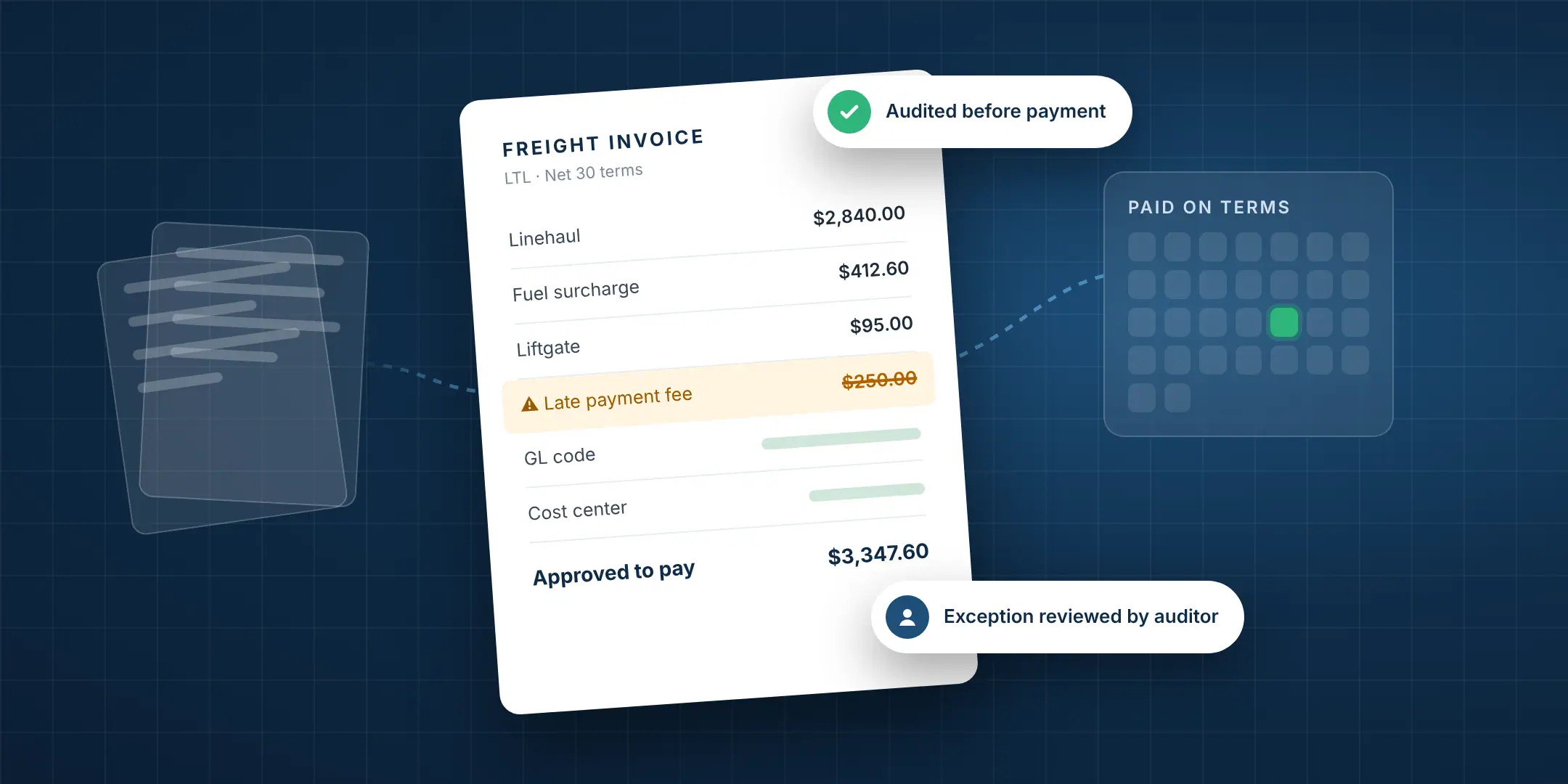
The pattern is familiar. A carrier enforces its payment terms. A late fee lands on an invoice that sat in an approval inbox for weeks. And the shipper usually had the cash to pay on time. The real problem lives in the process: manual approvals, scattered general ledger (GL) coding and approval chains that run through too many desks.
Automated freight audit fixes that process. Experienced auditors own the work, and AI-enabled technology handles the repetitive checks so they can focus on the invoices that need judgment. Done well, it protects working capital, keeps carrier relationships healthy and gives finance real control over transportation spend before the market turns.
Why Do Carrier Late Fees Keep Piling Up?
Carrier late fees pile up when carriers enforce their payment terms and shippers still process freight invoices by hand. Carriers run on thin margins. They need predictable cash to cover equipment payments, driver pay and fuel. When a shipper pays late, the carrier effectively finances that shipper’s freight, and fewer carriers will do that for free.
Meanwhile, invoices reach most enterprise shippers through several channels at once: electronic data interchange (EDI), application programming interfaces (APIs), carrier portals and PDFs attached to emails. When individual plants or business units manage their own freight, those invoices land with plant managers and shipping clerks. They check accessorial charges, confirm the delivery happened and work out the GL string, all before finance even records the liability.
Do the math on a 30-day payment term. If an invoice spends 21 days moving through email approvals, accounting has nine days left to catch an error, resolve it and pay. International shipments shrink the window further, since duties and taxes often come due on much shorter terms than domestic freight.
The cycle usually looks like this:
- No one clearly owns the invoice.
- The invoice bounces between departments.
- The due date passes, and late fees and credit holds follow.
One enterprise shipper we evaluated paid more than $250,000 a year in late fees. Their standard accounts payable aging rules conflicted with their carrier contract terms. They had the money. The process was the problem.
How Do Late Payments Weaken Your Carrier Leverage?
Late payments and billing disputes weaken carrier leverage because they tell carriers your account costs more to serve. Carriers weigh that cost at every contract renewal. Shippers that constantly dispute invoices miss deadlines or send payments without clear remittance detail pay for it in their rates.
Carriers watch Days Sales Outstanding (DSO) closely. If your company sits near the bottom of a carrier’s customer list for payment reliability, do not expect that carrier’s best pricing.
Few invoices in accounts payable carry as many moving parts as freight. Truckload and less-than-truckload (LTL) bills regularly include unapproved accessorials, freight reclassifications, missed discount tiers and fuel surcharges calculated incorrectly.
When stretched internal teams try to audit each line by hand on top of their other jobs, two things go wrong. Real overcharges slip through because no one has time to check every charge against complex rate tables. And valid invoices sit in long dispute cycles, often with the entire payment file on hold. Carriers grow frustrated, and remittances land on the wrong accounts.
That is why a strong freight bill audit and payment program does more than tidy up finance. It works as a procurement lever.
Why Is Freight GL Coding So Hard to Get Right?
Freight GL coding is hard because transportation charges rarely carry clean reference data at the line level. One shipment might touch several business units, several product categories and multiple legs. Without automated matching, someone in finance has to read through each bill and decide which facility or cost center absorbs each charge.
Volume makes it harder. A high-volume shipper can process thousands of freight invoice lines each month, and each one needs the right account code. Shippers with large catalogs often cannot see how accessorials chip away at margin on individual products. When spreadsheets drive GL coding, errors follow. Misallocated freight distorts division-level profitability and drags out month-end close.
Rogue accounts add to the mess. A business unit opens its own shipping account, and that account never picks up the corporate discount. When those bills arrive, accounting has nothing to validate them against. Invoice data often surfaces gaps like this long before a dashboard does, a point we covered in Freight Invoices Reveal Problems Before KPIs Do.
What Helps Streamline Freight GL Coding?
- Normalize the data: Pull electronic billing from LTL, truckload and drayage into one consistent structure.
- Match to source records: Automatically match every invoice against enterprise resource planning (ERP) purchase orders, bills of lading and shipment records.
- Automate GL distribution: Work with audit specialists to set allocation rules so freight, fuel and accessorial costs split to the right cost centers on every invoice, then keep those rules current as your business changes.
- Put experts on the exceptions: Send noncompliant invoices and unexplained variances to audit specialists and logistics managers who investigate and resolve them with the carrier and move invoices that pass every check to payment.
Why Does In-House Freight Audit Fall Behind?
In-house freight audit falls behind because carrier pricing changes faster than most internal teams can track. Many growing mid-market companies build their own audit process to avoid third-party fees. On paper, it saves money. In practice, it creates technical debt.
Rate structures, tariffs, accessorial rules and EDI standards change constantly. Every General Rate Increase (GRI) or carrier API update means someone in IT has to drop a core project to update billing tables. When IT runs short on bandwidth, those updates slip. Outdated rate tables then generate false audit exceptions, which delay payment and restart the late fee cycle.
Freight audit takes dedicated people, clean data and deep rate expertise. It rarely works as a side project. That is the work a dedicated freight audit team does every day: tracking every GRI, keeping rate tables current and working disputes directly with carriers, so your team does not have to.
How Does Automated Freight Audit Protect Working Capital?
Automated freight audit protects working capital by catching billing errors before payment, paying clean invoices on time and turning invoice data into spend intelligence procurement can use.
A strong freight audit team reviews 100% of freight invoices against contracted rates before any money goes out, using technology to run the routine checks at scale. The technology flags overcharges, duplicate bills, incorrect accessorials and invalid late fees up front, and audit specialists review and resolve those exceptions with the carrier before payment. That means no chasing refunds after the fact. Cash leaves the business only for services the carrier delivered.
Automation does not mean removing oversight. It means spending human attention where it matters. AI-enabled technology handles the high-volume checks consistently, and experienced auditors handle the disputes, contract interpretation, carrier conversations and unusual charges that require judgment.
At the same time, invoices that pass audit go on the payment schedule in line with each carrier’s negotiated terms. Electronic payment files go out with complete remittance detail, so carriers apply payments correctly and accounts stay off credit hold. Finance leaders also gain a clear view of total landed cost, cost per pound by lane, accessorial frequency and regional cost variances.
What Strengthens Freight Payment Execution?
- Audit before you pay: Check rate tables, discount tiers, accessorial rules and fuel surcharges before releasing funds, not after.
- Send clean remittance files: Give carrier receivables teams detailed remittance data so payments post to the right invoices.
- Manage every mode in one place: Handle domestic freight and international documentation in a single platform.
- Automate accruals and close: Use normalized billing data to build accurate monthly freight accruals and shorten the close.
Final Takeaway
Manual freight settlement drains margin quietly. Shippers that rely on email approvals, disconnected spreadsheets and inconsistent GL coding pay for it in late fees, weaker rate leverage and strained carrier relationships. When capacity tightens again, the carriers you treated well will be the ones that answer the phone.
Getting control of freight settlement does not require a fight with your carriers. It requires discipline. Shippers that automate freight bill audit and payment remove friction, protect working capital and become the customers carriers want to keep.
If late fees keep showing up on your freight bills, talk to our freight audit team about where your process stalls.
Frequently Asked Questions
What is automated freight audit?
Automated freight audit combines AI-enabled technology with experienced audit experts to check every freight invoice against contracted rates, shipment records and accessorial rules before payment. The technology flags errors automatically, and audit specialists review and resolve those exceptions before payment.
How does automated freight audit reduce carrier late fees?
It shortens the time between invoice receipt and approval. Invoices that pass audit move to payment on each carrier’s negotiated terms instead of sitting in email approval chains past their due dates.
What is the difference between freight audit and freight payment?
Freight audit confirms each invoice is accurate. Freight payment releases funds to carriers with the remittance detail they need to apply the payment. Combining both in one program lets shippers pay accurately and on time.
Can automated freight audit help with GL coding?
Yes. Rules-based allocation assigns freight, fuel and accessorial costs to the correct cost centers automatically, which reduces manual coding errors and speeds month-end close. Audit specialists set up and maintain those rules with your team.
Does automated freight audit remove human review?
No. AI-enabled technology handles routine checks on every invoice, and audit specialists review exceptions such as disputed charges, rate variances and unusual accessorials. People stay involved wherever an invoice needs judgment.
About Author:
More Blogs





On this article:
Sign Up for the TI Newsletter